Quick Summary
To remove wine stains from marble, apply a poultice: a thick paste, such as baking soda mixed with 3% hydrogen peroxide, spread about 1/4 inch thick, covered with plastic wrap, and left to sit for 24 to 48 hours. Scrape off the dried paste, rinse with distilled water, and repeat if a faint stain remains.
- Mix 3 parts baking soda with 1 part 3% hydrogen peroxide into a thick frosting.
- Spread the poultice about 1/4 inch thick, extending at least 1 inch past the stain edges.
- Let the poultice sit 24 to 48 hours, or up to 72 hours for old or deep stains.
- Never use vinegar, lemon juice, or other acids, since they etch marble and cause dull spots.
- Most wine stains lift in one to two poultice applications.
Table of Contents
- Why Wine Stains Set Into Marble
- Step-by-Step: Removing Wine Stains from Marble with a Poultice
- Is Vinegar Safe for Marble?
- When to Call a Professional Marble Restoration Service
- Frequently Asked Questions
Why Wine Stains Set Into Marble
Last Updated: November 4, 2026
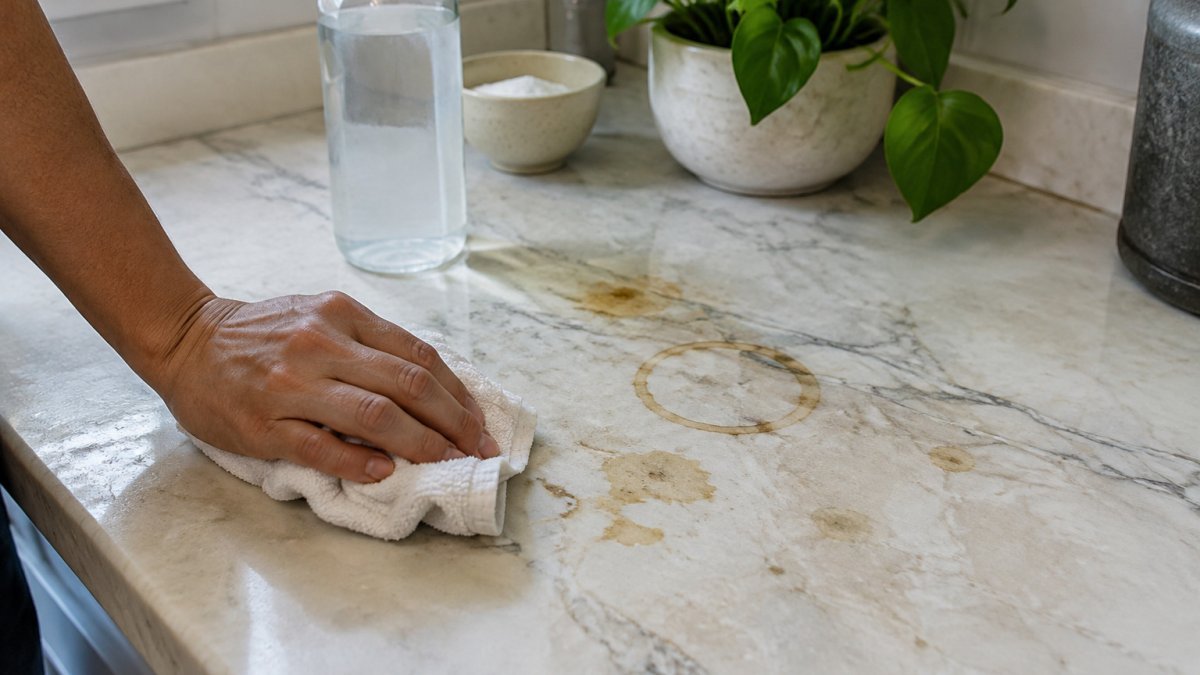
Red wine is one of the most common reasons homeowners call for stone help, and knowing how to remove wine stains from marble starts with understanding the stone. Marble is porous, and wine’s tannins and pigments soak into the surface. Wine stains on marble can often be lifted with the right method.
Marble is mostly calcium carbonate, making it acid-sensitive. Wine is acidic, so it can etch the surface as well as stain it: etching is a dull, cloudy spot; the stain is a colored discoloration in the pores.
The longer wine sits, the deeper it travels. Fresh spills often wipe away with a damp cloth, but dried stains need a poultice to pull the pigment out.
Step-by-Step: Removing Wine Stains from Marble with a Poultice
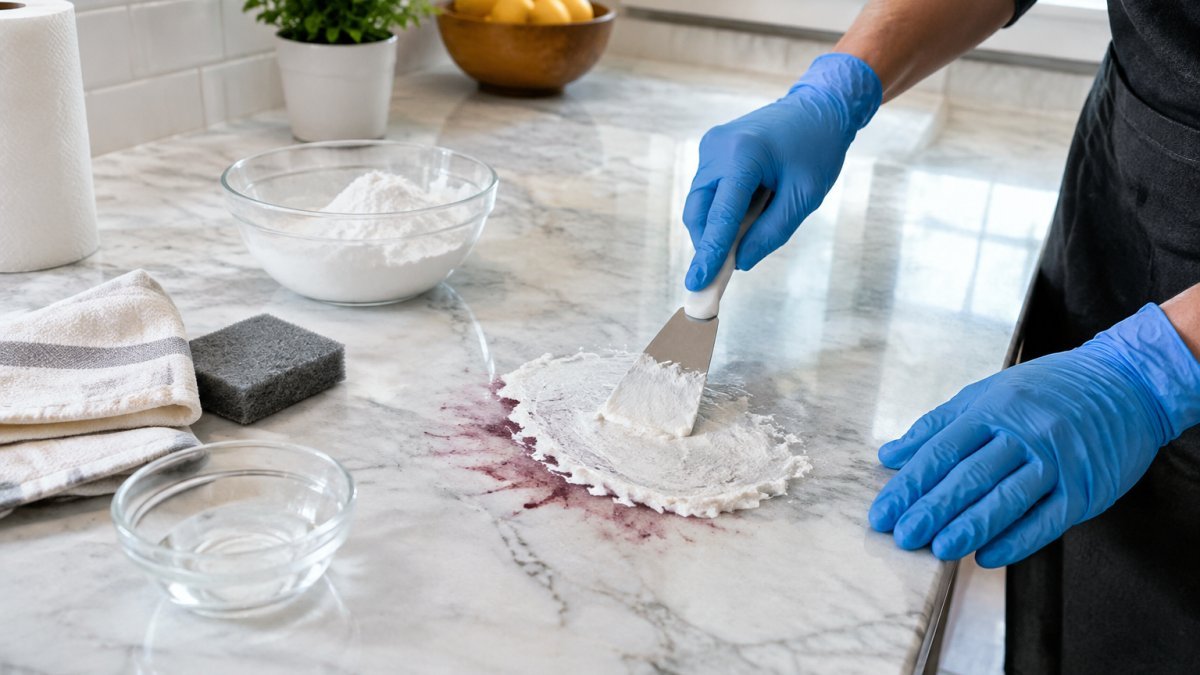
A poultice is a paste that draws the stain out through capillary action: as it dries, it pulls pigment-laden moisture from the pores into the absorbent material, where it can be scraped away. It works on fresh and dried stains, but the recipe and dwell time should match the stain’s age and the marble’s finish.
DIY Poultice Recipes
Household ingredients can also work for removing wine stains from marble when mixed correctly. Three safe recipes:
- Baking soda and hydrogen peroxide: Mix 3 parts baking soda to 1 part 3% hydrogen peroxide into a thick frosting. The go-to for red wine, since peroxide breaks down pigment. Do not use higher-strength peroxide.
- Baking soda and acetone: Mix 3 parts baking soda to 1 part acetone (nail polish remover). Acetone evaporates quickly, so cover tightly. Useful on honed marble where you want to avoid adding moisture.
- Kaolin clay and distilled water: Mix to a peanut-butter consistency. Gentler than baking soda on polished surfaces, and good for delicate or antique marble.
Avoid recipes with vinegar, lemon juice, or any acid, they etch the calcium carbonate and leave a dull spot no poultice can fix.
Step-by-Step Application
- Clean the surface with a pH-neutral stone cleaner and let it dry so the poultice contacts the stain directly.
- Mix your recipe to a thick frosting consistency that holds its shape on a spoon.
- Spread the paste about 1/4 inch thick over the stain, extending at least 1 inch past the edges.
- Cover with plastic wrap and tape the edges to hold moisture in; seal acetone recipes well.
- Let it sit 24 to 48 hours, or up to 72 hours for old or deep stains, checking at 24 hours that the paste is drying evenly.
- Remove the wrap, scrape off the dried paste with a plastic scraper, and rinse with distilled water.
- Dry and check. If the stain is lighter but visible, repeat. Most wine stains lift in one to two applications.
Watch out: never use a metal scraper, strong acid, or bleach on marble, it can scratch or etch the stone and worsen the damage.
Honed vs. Polished Marble
Polished marble has a tight, reflective surface that is more sensitive to etching and abrasives; use kaolin clay or a fine baking soda paste and avoid scrubbing. Honed marble has a matte finish with slightly more open pores, so it accepts a baking soda poultice well but dries faster, check at 24 hours and mist with distilled water if it cracks. On either finish, never poultice an already etched surface; the etch needs polishing out first.
!Gloved hands spreading a white paste poultice over a stained marble countertop
Call a marble contractor today for a free estimate! →
The article lays out how each poultice recipe is mixed and how long it should sit, so the key details are easy to compare.
| Recipe | Mix | Dwell time |
|---|---|---|
| Baking soda and hydrogen peroxide | 3 parts baking soda to 1 part 3% peroxide | 24 to 48 hours |
| Baking soda and acetone | 3 parts baking soda to 1 part acetone | 24 to 48 hours |
| Kaolin clay and distilled water | Peanut-butter consistency | 24 to 48 hours |
Is Vinegar Safe for Marble?
No. Vinegar’s acetic acid reacts with the calcium carbonate in marble, converting surface calcium carbonate into water-soluble calcium acetate that washes away, leaving a dull, etched spot. That etch is physical damage, not a stain, and no poultice will remove it, only mechanical polishing restores the shine.
The same chemistry makes wine stains a two-part problem: tannins and pigments soak into the pores and stain, while acids (tartaric, malic, citric) etch the calcium carbonate. A fresh spill may leave both a colored mark and a dull spot; the poultice removes the stain, the etch needs polishing.
A pH-neutral stone cleaner is a common everyday option. Look for products labeled pH-neutral and safe for natural stone, and avoid anything with vinegar, lemon, or ammonia. For routine cleaning, a few drops of pH-neutral cleaner in distilled water and a microfiber cloth is enough. Save the poultice for stains that need more power, and never use vinegar as a spot cleaner on marble, even diluted.
Watch out: if you have already used vinegar and see a dull spot, do not apply more cleaner, the etch needs professional polishing, and repeated acid exposure will deepen it.
When to Call a Professional Marble Restoration Service
Some stains and damage are beyond a home fix. Call a professional if the stain is old or large, if the surface is etched or chipped, or if the marble is in a high-traffic commercial space. Marble and stone restoration for floors and countertops explains what a professional service covers. Johnny Stone Work provides marble polishing, cleaning, sealing, and repair for homes and businesses across the New York area, and offers free estimates. Contact Johnny Stone Work to schedule a free estimate for your stone. Marble repair services for countertops, floors, and more cover the surfaces this article describes. Get a free quote from Johnny Stone Work if your stone needs professional attention.
Frequently Asked Questions
How can I remove red wine stains from marble?
Blot up excess wine immediately with a clean cloth. For set stains, mix a poultice of hydrogen peroxide and baking soda or a commercial poultice powder to a thick paste, spread it about a quarter inch thick over the stain, cover it with plastic wrap taped at the edges, and leave it for 24 to 48 hours. Remove the paste, rinse with water, and dry the surface. Repeat if needed. Avoid scrubbing hard, since abrasion dulls the polish. If the stain persists after two or three attempts, a professional can assess whether it needs a stronger treatment.
Is rubbing alcohol ok on marble?
Rubbing alcohol is generally safe for sealed marble when used in small amounts and wiped off promptly, but it is not a reliable stain remover on its own. It can dissolve some organic residue and help lift surface stains, yet it may not reach stains that have penetrated the stone. Use it as a spot-test first in an inconspicuous area. Because marble is calcium carbonate, avoid letting any cleaner sit on the surface, and always rinse and dry the area afterward to prevent residue from dulling the finish.
Is vinegar safe to use on marble?
No. Vinegar is acidic and reacts with the calcium carbonate in marble, which causes etching: a dull, rough spot where the polish has been removed. Acidic cleaners can also weaken the sealer over time. Use a pH-neutral stone cleaner or a mild soap and water solution instead. If you have already used vinegar and see dull spots, a professional polishing service can often restore the finish.
Protect your marble after cleaning with a sealer that resists future staining. Learn about professional marble sealing services from Johnny Stone Work.