Last Updated: November 16, 2026
Quick Summary
Marble lobby restoration is the process of returning worn, dulled, or damaged stone floors to a clean, even, polished finish through inspection, grinding, honing, polishing, and sealing. It is usually a better option than replacement when the stone is structurally sound and damage is limited to the surface.
- Inspect the floor in daylight and building lighting, and confirm the stone type before any treatment.
- Restoration suits surface wear, etching, and light stains; replacement is needed for cracked or loose tiles.
- Diamond grinding, honing, and polishing proceed through progressively finer abrasives in sequence.
- Phase the work by zone and schedule it around occupants, with barriers and clear access routes.
- Compare quotes by checking that each one covers grinding, sealing, containment, and disposal.
Table of Contents
- What Marble Lobby Restoration Involves for Commercial Buildings
- Inspecting Your Lobby Floor Before Choosing a Treatment
- Marble Restoration vs. Replacement: How to Decide
- How Marble Floor Honing and Polishing Work
- Commercial Marble Floor Restoration: Planning Around Occupants
- Marble Floor Restoration Cost: What Drives the Price
- Sealing, Maintenance Schedules, and Measuring Results
- Vetting a Lobby Restoration Contractor and Booking Your Project
- Frequently Asked Questions
What Marble Lobby Restoration Involves for Commercial Buildings
Marble lobby restoration for buildings is the process of bringing worn, dulled, or damaged stone floors back to a clean, even, and polished finish, usually through grinding, honing, polishing, and sealing. The lobby is the first impression for every tenant, visitor, and delivery driver who walks through the door, so the floor deserves the same care as the façade.
The work is a sequence, not a single treatment: assess the stone, clean deeply, correct etching and scratches, refine with progressively finer abrasives, then seal. Skipping inspection and jumping straight to polishing often leaves a floor looking good for a few weeks before it dulls again.
Restoration differs from routine maintenance. Daily dust mopping keeps a floor presentable but does not remove embedded wear or restore lost sheen. Restoration removes a measured thickness of stone to reach fresh material, then rebuilds the finish, the difference between a tired floor and one that looks newly installed.
Inspecting Your Lobby Floor Before Choosing a Treatment
Before any equipment comes out, the floor needs a careful inspection. Walk the entire lobby in both daylight and under the lighting the building normally uses, because scratches and dull patches often show up only at certain angles. Mark areas with heavy wear, visible stains, chips, cracks, and any spots where the finish has lifted or gone cloudy.
Identify the stone type, since marble, travertine, limestone, granite, and terrazzo respond differently to abrasives and chemicals. A common mistake is assuming a floor is marble when it is porcelain or engineered stone. Acidic cleaners that suit some stones etch others, so confirming the material first prevents damage.
Look at the wear pattern, too. Heavy wear at entrances, elevator banks, and reception desks calls for a different approach than uniform dullness. Document findings with photographs and notes, that record becomes the baseline for estimating work and measuring results.
Marble Restoration vs. Replacement: How to Decide
Restoration and replacement solve different problems, and the right choice depends on how deep the damage goes and what the building needs. Restoration is often the better option when the stone is structurally sound and the damage is confined to the surface, such as scratches, etching, dullness, and light staining. Replacement becomes necessary when tiles are cracked through, loose, delaminated, or badly chipped at the edges, or when the stone is too thin to withstand another grinding pass. For valuable historic or architectural stone, you can review a specialist’s certified cathedral limestone restoration before deciding.
| Factor | Restoration | Full Replacement |
|---|---|---|
| Best for | Surface wear, etching, dullness, light stains | Cracked, loose, or structurally failed tiles |
| Disruption | Phased work, often in sections | Extensive, usually requires longer closures |
| Stone matching | Keeps the original stone and finish | New stone may not match age or color |
| Remaining thickness | Requires enough stone to grind safely | Not limited by remaining thickness |
| Typical outcome | Renewed finish on existing stone | Entirely new surface |
Stone matching is often overlooked. Quarried marble varies by batch, and replacement tiles differ in veining, tone, and polish even when the species matches. For historic lobbies, restoring existing stone preserves continuity replacement cannot reproduce. Get a restoration assessment first, many floors that look ready for replacement can be brought back to a clean, even finish.
How Marble Floor Honing and Polishing Work
Honing and polishing are the core mechanical steps that bring a marble floor back to its finish. The process uses a series of diamond abrasives, starting coarse and moving progressively finer. Each grit removes the scratches left by the previous one, and the final pass creates the reflective surface that makes a lobby look new. Skipping grits or rushing the sequence leaves visible scratch patterns that show up once the floor is sealed and in use.
Honing produces a satin or matte finish by refining the surface without high gloss. Polishing goes further, producing the mirror-like shine many commercial clients want. The right level depends on the building’s style and traffic; high-gloss shows scratches and footprints more readily, so some buildings choose honed finishes for high-traffic corridors.
Machines matter as much as abrasives. Low-speed floor machines with controlled pressure keep the surface even, while inconsistent passes create uneven patches that catch the light. Water cools the diamond pads and carries away slurry, and dust control matters because stone dust settles on adjacent surfaces and equipment.
Diamond Grinding, Honing, and Polishing Explained
Diamond grinding is the most aggressive stage, used to level the surface and remove deep etching, heavy scratches, or uneven spots. It is typically done with coarse metal-bonded diamond pads and removes the most material, so it is used sparingly. Grinding is what makes a floor flat again, but it also reduces the stone’s thickness, which is why an assessment of remaining stone comes first.
Honing follows grinding with finer resin-bonded pads to smooth the scratches left behind. This stage sets the final gloss level and creates a uniform surface ready for polishing. Uneven honing shows up as cloudy streaks once polish is applied.
Polishing finishes the job with the finest abrasives and often a polishing compound. A floor ground and honed carefully polishes to a clear, deep sheen; shortcuts show through as haze or dull spots.
Removing Etching, Scratches, and Stains
Etching is a dull, frosted mark caused by acid reacting with the stone’s surface, often from cleaning products, spilled drinks, or acidic foods. Because etching is part of the surface itself, it cannot be wiped away and must be ground out.
Scratches range from fine abrasion marks to deep gouges. Fine scratches usually disappear during honing and polishing, while deeper ones may need grinding and a return to coarser abrasives. Every scratch ground out thins the stone slightly, which is why thorough inspection matters before a full pass.
Stains require a different approach. Organic stains, metal stains, and oil stains each respond to different poultices and cleaners, and some stains are embedded deep enough that they will not come out entirely. A realistic restoration plan tells the client which stains can be removed, which will be reduced, and which may remain, rather than promising a flawless result.
Commercial Marble Floor Restoration: Planning Around Occupants
A lobby is a working space, and restoration has to fit around the people who use it every day. The first step is a phased schedule that divides the floor into zones, so the building never loses all of its entry points at once.
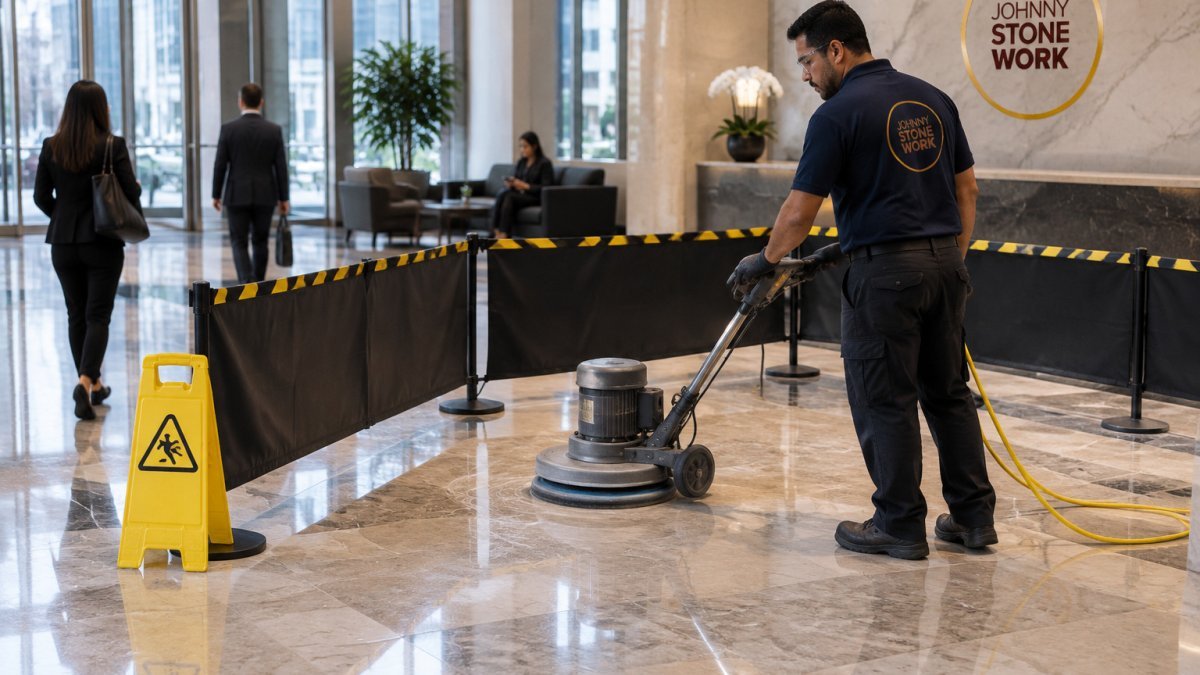
Worksite safety is central. Slurry and water on polished stone create slip hazards, so the work zone needs barriers, warning signs, and wet-floor markers. Tenants need a clearly marked path around the active area, and crews should keep the zone clean as they move between sections.
Dust and air quality deserve attention. Grinding and honing generate fine stone dust that can drift into offices and HVAC intakes. Containment barriers, wet methods, and filtered vacuums reduce the spread, and managers may want to adjust ventilation during dusty stages. Clear communication about each phase prevents most complaints.
Watch out: Sealers and some cleaning products can release strong odors while curing. Ask the contractor which products will be used and schedule sealing for a time when the area can be kept closed off and ventilated.
Marble Floor Restoration Cost: What Drives the Price
Restoration pricing is often quoted per square foot, with the rate depending on treatment depth rather than stone alone. When comparing bids, ask each contractor to price the same scope so the quotes are comparable, and confirm which treatment levels each figure covers.
Square footage is only the starting number. Several cost drivers commonly move a quote:
- Treatment depth. Diamond grinding removes the most material and takes the most passes, so it carries the highest labor cost per square foot. Honing and polishing alone sit at the low end. A floor that needs grinding across the whole lobby rather than spot grinding at entrances can shift the estimate substantially.
- Stone type and condition. Dense, hard stone takes longer to cut and polish than softer stone. Cracked, chipped, or lippage-affected tiles add repair time before any finishing begins, and stains that need poultice cycles add labor that is not captured in a per-square-foot finishing rate.
- Phasing and access. Work split into night shifts or weekends to keep the lobby open carries shift premiums and longer mobilization. Elevator-only equipment access, freight scheduling, and building security check-in all add non-productive time that a contractor must price into the job.
- Occupant protection and containment. Barriers, negative-air containment, wet methods, and filtered vacuums are line items. A bid that omits them is not cheaper; it is incomplete.
- Sealing and finish level. A penetrating sealer applied after polishing is a modest add. A high-gloss finish that requires additional polishing passes, or a topical coating that needs multiple coats and cure time, adds labor and schedule.
- Disposal and water handling. Slurry and stone waste must be contained and disposed of properly, and water use must be managed in an occupied building. These are real costs that vary by site.
To read a quote, divide the total by the square footage and check what that number includes. If one bid is dramatically lower, confirm whether it covers grinding, sealing, containment, and after-hours premiums, or whether it is a polish-only scope dressed up as restoration.
Watch out: A per-square-foot rate quoted before the contractor has inspected the stone and measured the damage is a guess, not an estimate.
For an accurate figure, request a site assessment and a written quote from Johnny Stone Work, which offers free estimates. You can also review the marble and stone restoration services offered for floors and countertops to see how the work is scoped.
Sealing, Maintenance Schedules, and Measuring Results
Sealing protects the restored finish from stains and moisture, though it does not make stone impervious. Sealers are typically applied after the final polish has cured, and the type should match the stone and the expected traffic.
Maintenance determines how long a restoration lasts. For busy lobbies: daily dust mopping with a pH-neutral cleaner, weekly damp mopping, and periodic burnishing between full restorations. Avoid acidic cleaners, abrasive pads, and harsh chemicals, which etch the surface and undo the work. Entrance mats cut down grit, a major contributor to scratching.
Measure results to keep the program honest. Compare before-and-after photographs, check gloss readings where available, and inspect high-traffic zones every few months. A simple maintenance log shows when a floor is drifting back toward needing attention, so the next treatment happens before damage gets expensive.
Watch out: Restoration is not a permanent fix. Without daily protection and periodic maintenance, a restored floor can lose its shine within a relatively short period, especially in high-traffic lobbies.
Vetting a Lobby Restoration Contractor and Booking Your Project
Most building managers evaluate restoration contractors on price and a reference call, which is why so many projects end in disputes over scope.
Build a scope-of-work checklist before you call anyone. A complete restoration scope should state, at minimum:
- Stone type and finish level for each zone (entrance, elevator bank, reception, corridors)
- Inspection findings and the specific defects to be corrected (etching, scratches, lippage, cracks, stains)
- Treatment sequence: grinding, honing grits, polishing, and sealing products by name
- Containment method for dust and slurry, and the water source and disposal plan
- Phasing plan with work hours, access routes, and elevator scheduling
- Occupant protection: barriers, signage, and the path tenants will use
- Protection of adjacent surfaces, including walls, metal trim, and glass
- Cleanup, final inspection, and the acceptance criteria for the finish
- Insurance certificates and the named insured on the policy
- Payment schedule tied to milestones, not to a calendar
Score the bids on the same criteria. Use a matrix: scope completeness, sample quality, phasing plan, containment and safety plan, insurance and licensing, references from comparable lobbies, and price.
Ask the questions that separate operators from salespeople. Who will be on site, and are they employees or subcontractors? What is the grit sequence, and why that sequence for this stone?
Confirm insurance and licensing in writing. Ask for a certificate of liability insurance and workers’ compensation coverage, and verify the named insured matches the bidding company.
Book with a written agreement, not a handshake. The contract should attach the scope of work, approved sample standard, schedule, payment milestones, and change-order process for mid-project conditions.
Once you have shortlisted a contractor, request a site visit and a written estimate that spells out the scope, schedule, and exclusions. You can contact us to schedule a site visit.
Frequently Asked Questions
How much does it cost to resurface marble?
Marble resurfacing cost depends on floor area, the stone’s condition, how deep the scratches or etching go, and whether the work is done on site after hours. Pricing also changes with the number of passes needed for honing and polishing and the sealing product used. Because these factors vary by building, Johnny Stone Work provides a free estimate after inspecting the surface. Request a quote through the website to get pricing based on your specific lobby.
How long does marble lobby restoration take?
Timing depends on the square footage, how much material must be removed, and whether the work can be phased around building traffic. A typical lobby is restored in stages so the entrance stays usable, with cured sealer applied last. Plan for protective barriers, dust control, and a sealer cure period before heavy foot traffic returns. Your contractor should give a written schedule that shows each phase and when the floor can be walked on.
Can scratched or dull marble lobby floors be restored without replacement?
In many cases, yes. Surface scratches, dullness, and light etching can usually be removed by diamond grinding, honing, and polishing, which restores the original clarity without replacing tiles. Deep cracks, broken tiles, or heavily worn areas may need repair or partial replacement. A proper inspection determines whether the stone has enough thickness left to be honed and whether the finish can be matched.
What does professional marble lobby restoration include?
A complete service usually covers an initial inspection, protection of adjacent surfaces, deep cleaning, removal of etching and scratches, diamond grinding if needed, honing to a uniform finish, polishing to the target shine, and sealing or crystallizing for protection. Good contractors also document the stone’s condition before and after work and explain the maintenance schedule needed to keep results.
How should building managers compare marble restoration contractors?
Ask each contractor for references from comparable commercial lobbies, proof of insurance, and a written scope that lists each restoration step. Compare how they plan around occupants, their dust and barrier controls, and their finish-matching approach. Request before-and-after photos from similar projects. Avoid deciding on price alone, since a low bid that skips grinding or sealing often produces a floor that needs redoing sooner.
How much does it cost to restore an old building?
Building-wide restoration costs vary widely, so this guide focuses on the marble lobby and stone surfaces. For a lobby, cost is shaped by the stone type, the extent of etching or damage, access limitations, and the finish you want. Johnny Stone Work offers free estimates for commercial stone restoration, and the on-site inspection is the most reliable way to understand what your floor needs.
Is marble floor honing and polishing a permanent fix?
Honing and polishing restore the surface and remove wear, but the shine fades as the floor gets foot traffic. Sealing and a regular maintenance schedule extend the results considerably. Commercial lobbies typically need routine cleaning and periodic re-polishing or re-sealing, and the interval depends on traffic volume and the cleaning products used.
What is the difference between honing and polishing marble?
Honing uses progressively finer abrasives to flatten the surface and remove scratches, etching, and dullness, producing a satin or honed finish. Polishing follows honing to create a high-gloss shine. Some lobbies are left honed for a lower-maintenance look, while others are polished for a more formal appearance. The right choice depends on the design intent and how much traffic the floor carries.