Last Updated: November 19, 2026
Quick Summary
Professional granite countertop chip repair is the safer choice once a chip is more than cosmetic, deep, on an edge or corner, near a seam, or on a surface where appearance matters. Small, shallow chips on flat, low-traffic surfaces are fair game for a careful DIY kit, but edge chips require rebuilding the profile.
- A shallow surface nick no deeper than a fingernail is usually a DIY candidate.
- A granite chip repair kit fills shallow nicks but cannot restore a chipped edge profile or bevel.
- Edge chips require building up material in layers, then re-shaping and polishing the edge to match the original contour.
- Pricing is usually quoted per job rather than per square foot, driven by labor time, material matching, and finishing.
- Replace only when the stone is cracked through, the damage is widespread, or the repair cost approaches replacement.
Table of Contents
- Why Granite Chips and What They Mean for Your Countertop
- DIY or Professional Granite Countertop Chip Repair: How to Decide
- What a Granite Chip Repair Kit Can and Cannot Do
- Step-by-Step: Filling a Minor Chip Yourself
- Granite Edge Chip Repair: Why Edges Need a Different Approach
- How the Professional Repair Process Works
- What Professional Granite Countertop Chip Repair Costs
- Judging Professional Granite Countertop Chip Repair Reviews
- Repair or Replace? Matching the Fix to the Damage
- Book a Free Estimate for Your Granite Chip Repair
- Frequently Asked Questions
Why Granite Chips and What They Mean for Your Countertop
A chip in a granite countertop is a localized loss of stone material, usually at an edge, corner, or seam, that exposes the raw surface beneath the polished finish. Left alone, that small defect becomes a weak point where moisture and impact do more damage. A chip should be treated as a structural warning, not just a cosmetic flaw.
Granite is tough, but it is not indestructible. The same hardness that makes it a good work surface makes it brittle under a sharp, concentrated blow. A dropped cast-iron pan, a heavy can swung against an overhang, or a chair back rapped against the edge can all take a bite out of the stone. The chip itself is rarely the real problem. The real problem is what the chip lets in.
Below, we’ll show you how to tell a cosmetic chip from a structural one, when a repair kit is enough, and when calling in a pro is the better choice.
Common Causes of Surface Damage
Impact is the leading cause, but it isn’t the only one. A common mistake is assuming granite damage always comes from a single dramatic accident. In practice, most chips we see develop from repeated small stresses.
- Edge impact: Pots, pans, and dishware striking the countertop edge, the most exposed and unsupported part of the slab.
- Improper lifting: Dragging an appliance or heavy box across the surface instead of lifting it.
- Thermal shock: Placing a hot pan directly on a cold countertop can cause small fractures that later chip.
- Seam failure: A weak or failing seam between two slab sections is a chip waiting to happen.
- Fabrication flaws: A poorly finished edge is thinner and more fragile than a properly beveled one.
Assessing Chip Size, Depth, and Location
Before you touch anything, judge the damage honestly. This single assessment decides whether you reach for a tube of epoxy or a phone.
A shallow surface nick, no deeper than a fingernail, is usually a DIY candidate. A chip that goes deeper than the polished layer, or one that reveals a lighter, rougher interior, needs more care. Location matters just as much. Edge chips take the most abuse and are the hardest to hide. Interior chips on the flat work surface are easier to fill and blend.
Watch out: if you can see a crack radiating out from the chip, stop. Filling over a crack traps the problem and it will spread. That is a professional call.
DIY or Professional Granite Countertop Chip Repair: How to Decide
The honest answer is that professional granite countertop chip repair makes sense the moment the damage is more than cosmetic, or the moment appearance really matters. Small, shallow chips on a low-traffic surface are fair game for a careful homeowner. Everything else is a job for someone who does it every week.
If the chip is small, shallow, on a flat surface, and you can accept a visible repair, you may try it yourself. If it is deep, on an edge or corner, near a seam, or in a kitchen you care about, hiring a professional is the safer choice.
If you’re leaning toward the DIY route, our guide to 7 steps to fix deep scratches in granite walks through the hands-on techniques that overlap with chip repair.
What a Granite Chip Repair Kit Can and Cannot Do
A granite chip repair kit is a packaged set of color-matched epoxy or resin, hardener, mixing tools, and often a small polishing compound, designed for filling shallow surface defects. It works well within a narrow band of damage and fails predictably outside it.
What a kit handles well:
- Shallow surface nicks and pits
- Small chips on flat, horizontal surfaces
- Cosmetic touch-ups where a near-match is good enough
What a kit cannot do:
- Restore a chipped edge profile or bevel
- Match complex veining or a mottled stone pattern
- Fix a chip that has cracked the surrounding stone
- Deliver an invisible, seamless repair on a premium surface
The gap between “filled” and “seamless” is where most DIY results fall short. A kit gets the hole closed. It rarely gets the repair to disappear.
Step-by-Step: Filling a Minor Chip Yourself
For a small, shallow chip on a flat surface, a careful DIY repair can hold up well. Work slowly, keep the area clean, and don’t rush the cure. Here’s the sequence we’d follow.
Cleaning and Preparing the Area
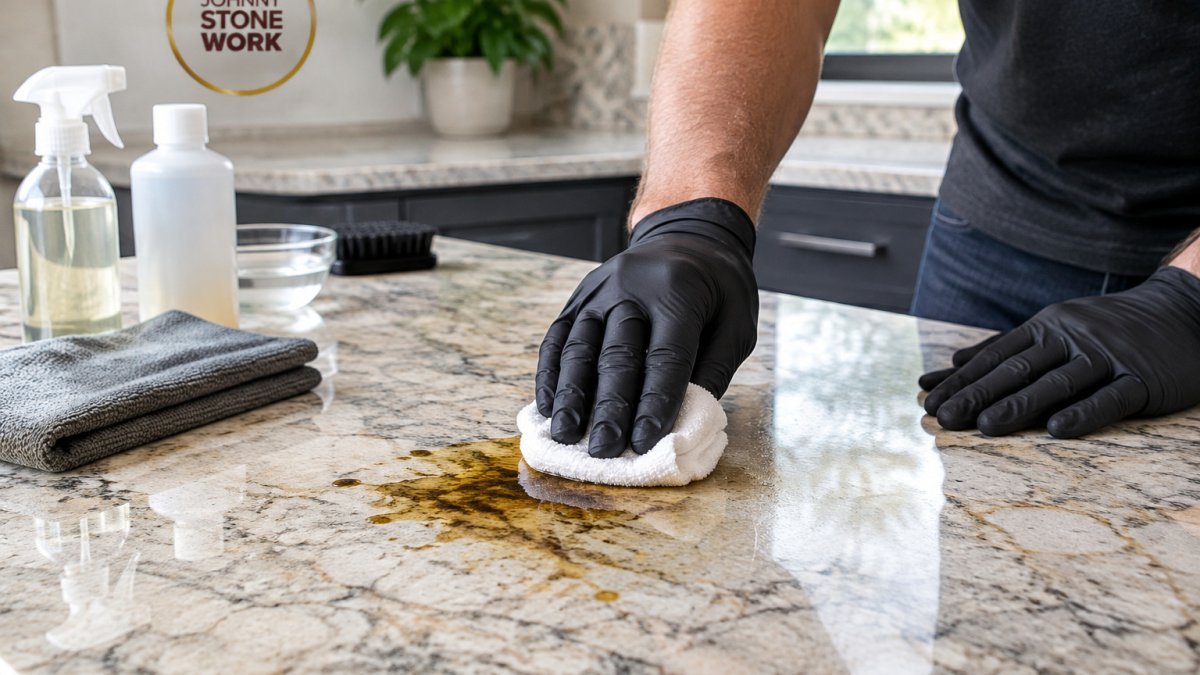
Clean the chip and surrounding stone with a degreaser or isopropyl alcohol, then let it dry completely. Any dust, oil, or moisture under the fill ruins adhesion. Use a pick or soft brush to lift loose grit out of the chip. Mask the edges around the chip with tape to keep excess epoxy off the polished surface.
Mixing, Applying, and Color Matching Epoxy
Color matching is the hardest part. Mix a small amount of epoxy with pigment until it matches the surrounding stone, testing the color on a scrap or the tape before applying. For a high-viscosity adhesive, use a pick or small stick to work the epoxy into the chip, slightly overfilling it. Low-viscosity adhesive is better for hairline cracks that need to wick into a narrow space. Cyanoacrylate with an activator can work for tiny surface nicks, but it cures fast and leaves little room for error.
Curing, Removing Excess, and Polishing
Let the epoxy cure fully, following the product’s stated drying time, and don’t touch it early. Once cured, use a razor blade held nearly flat to shave off excess, then wet-sand with progressively finer grits and polish to blend the repair into the surrounding finish. Expect some visible difference in sheen; a perfect match is rare with a kit.
Granite Edge Chip Repair: Why Edges Need a Different Approach
Edge chips are a different animal. The countertop edge is a shaped profile, often beveled or rounded, and a chip there removes part of that shape. Filling it flat leaves a lumpy, obvious patch that catches light and cloths.
Edge repair generally involves rebuilding the profile, not just the hole, which means building up the missing material in layers, then re-shaping and polishing the edge to match the original contour. A DIY fill on an edge often reads as a repair from across the room.
If you’re dealing with related surface damage, our overview of professional granite scratch repair explains what a proper restoration involves.
How the Professional Repair Process Works
Professional granite countertop chip repair follows a defined process built around assessment, color matching, and finish. The steps look similar to a careful DIY attempt on paper, but the execution, the materials, and the finishing standards are what separate a repair that disappears from one that reads as a patch.
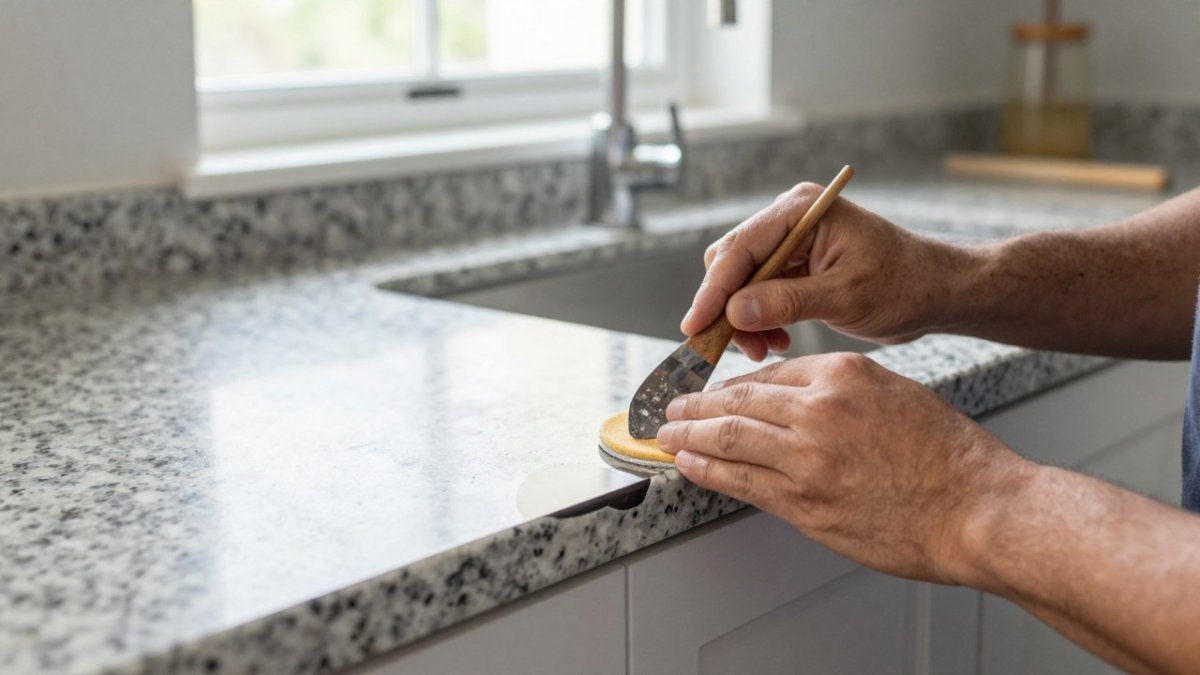
A typical professional visit generally involves the following steps:
- Assessment and damage classification. The technician confirms the chip is cosmetic, checks for hairline cracks radiating from it, tests seam integrity, and looks for any loose or hollow-sounding stone around the damage. This step decides whether the job is a fill or whether the stone needs stabilization first. A chip over a crack is not a fill job; the crack has to be addressed or the repair will fail.
- Surface preparation. The area is cleaned with a degreaser or isopropyl alcohol and dried completely. Loose grit is lifted out of the chip with a pick or a soft brush, and the surrounding polished surface is masked so excess filler does not bond to it. Any oil or moisture left under the fill ruins adhesion, which is why this step is not rushed.
- Color matching. This is where most of the skill lives. The technician mixes epoxy or resin with pigments, often blending two or more tones to match the stone’s base color and its mineral flecks. On veined or mottled stone, the match is built in layers so the fill carries some of the pattern rather than sitting as a flat spot. A test dab on tape or a scrap is compared under the room’s actual lighting before the fill goes in.
- Fill and build. The mixed material is worked into the chip with a pick or a small stick, slightly overfilling so there is material to sand back. On edges and corners, the fill is built up in layers and shaped toward the original profile rather than simply leveled flat. Deep chips may need two or three applications with cure time between them.
- Cure. The fill is left to cure fully per the product’s instructions. Touching or sanding early smears the material and ruins the color match, so the cure time is treated as part of the job, not dead time.
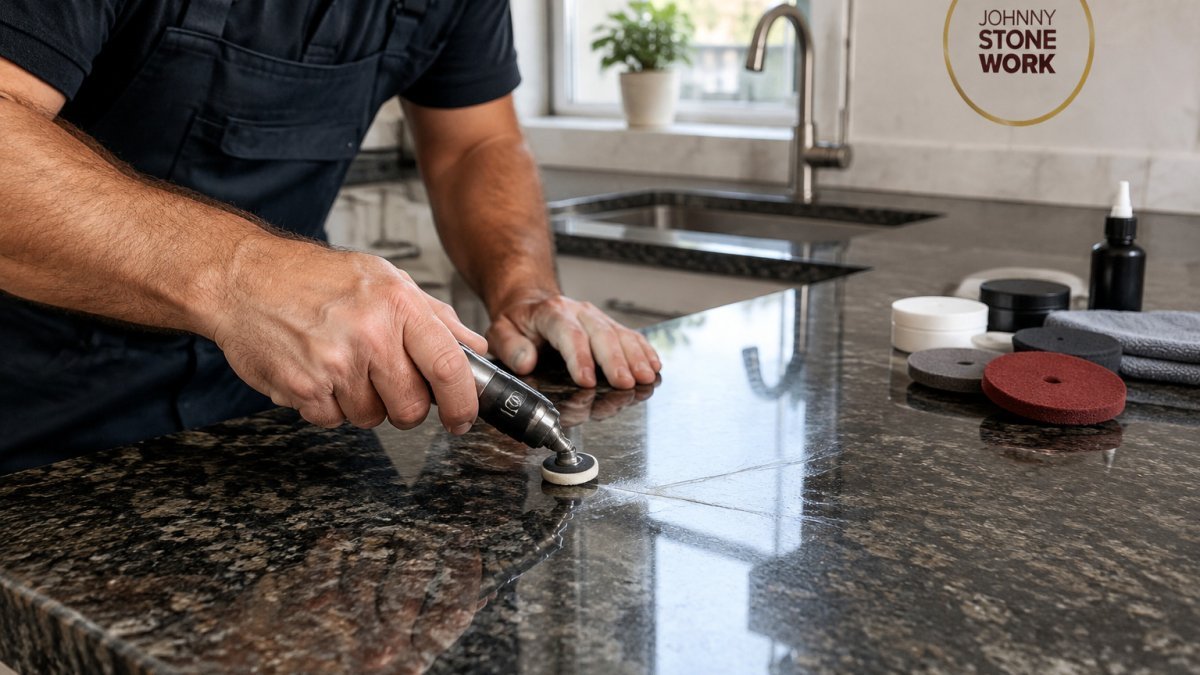
- Shape, level, and polish. Excess filler is shaved back with a razor blade held nearly flat, then wet-sanded with progressively finer grits and polished to blend the sheen into the surrounding finish. On edges, the technician re-shapes the profile with abrasives before polishing. This is the step that determines whether the repair is visible from across the room.
- Seal and final inspection. A sealer is applied to protect the repair and the surrounding stone, and the technician inspects the work under the room’s lighting from several angles before cleanup.
Watch out: a repair that looks perfect under bright work lighting but shows a dull patch in daylight usually means the polishing step was cut short or the filler was not matched for sheen, not just color. Checking the finished repair under the room’s normal lighting before work is complete is a sensible step.
To see what a full service visit entails, read our guide to granite countertop polishing service.
What Professional Granite Countertop Chip Repair Costs
Pricing for professional granite countertop chip repair is usually quoted per job rather than per square foot, because the work is driven by labor time, material matching, and finishing rather than surface area. Quotes for stone repair are often structured around a minimum service charge plus time and materials, so bundling several small repairs into one visit may help reduce the overall cost.
Here is how the cost drivers break down, and why each one moves the number.
- Chip size and depth: A shallow surface nick is a fill-and-polish job measured in minutes. A deep chip that exposes the rough interior of the slab requires layered build-up, longer cure time between layers, and more finishing, which pushes the job toward the higher end of a shop’s range.
- Location on the countertop: Flat interior chips are the fastest to repair because the technician works on a horizontal surface with room to sand and polish. Edge and corner chips take longer because the profile has to be rebuilt and re-shaped, and the technician often has to work upside down or at an awkward angle.
- Stone color and pattern: A uniform, fine-grained granite is straightforward to color-match. A stone with dramatic veining, large mineral inclusions, or a mottled pattern requires blending two or more pigments and sometimes hand-detailing the fill so the repair does not read as a flat spot. That skill premium is real and shows up in the quote.
- Access and site conditions: An island in an open kitchen is easy to reach. A countertop crowded with appliances, a tight galley, or a commercial space that has to stay open during the work adds setup and protection time.
- Additional damage found on site: A chip with a radiating crack, a failing seam nearby, or a section of stone that has come loose changes the scope. The technician may need to stabilize the crack or re-seam before filling, and that is quoted separately.
- Travel and scheduling: Shops price travel into the minimum or add a trip charge beyond a certain radius. Emergency or same-week scheduling can also carry a premium.
Quotes may be presented as a flat fee for the repair rather than an hourly rate. Ask what any quote includes, such as color matching, polishing, sealing, and cleanup, so that quotes can be compared on the same scope.
Watch out: a quote given without seeing the stone is an estimate at best. Asking for photos or an in-person look before committing to a number is a sensible step when comparing quotes.
The most reliable way to know your cost is an estimate based on the actual chip. Johnny Stone Work offers free estimates, and current pricing is available through the company’s website or by requesting a quote.
Judging Professional Granite Countertop Chip Repair Reviews
Reviews can offer insight into workmanship. When evaluating a repair company, reading for specifics rather than star ratings is helpful.
Look for reviews that mention:
- Whether the repair was invisible or still visible afterward
- How the company handled color matching on veined or patterned stone
- Punctuality, cleanliness, and whether the crew protected the kitchen
- Follow-up if something wasn’t right
A common mistake is trusting a five-star average built on unrelated services. A company that does great bathtub resurfacing may not be your best bet for a granite edge chip. Read the reviews that mention stone repair specifically. You can see our own customer feedback on our reviews page.
Repair or Replace? Matching the Fix to the Damage
Replacement is often not the first step, since many chips can be repaired. The question is whether the repair will hold and look right.
| Damage Type | Recommended Fix | Why |
|---|---|---|
| Shallow surface nick | DIY kit or pro touch-up | Low risk, cosmetic |
| Deep flat-surface chip | Professional fill | Needs proper color match and finish |
| Edge or corner chip | Professional edge repair | Profile must be rebuilt and polished |
| Chip with radiating crack | Professional assessment | Crack may spread; filling alone won’t fix it |
| Multiple chips or failing seam | Professional restoration or partial replacement | Underlying weakness needs addressing |
Replace only when the stone is cracked through, the damage is widespread, or the repair cost approaches replacement. For many single chips, repair can preserve the original slab.
Book a Free Estimate for Your Granite Chip Repair
A chip is easier to address when it is handled early, before moisture and further impact enlarge it. Every week you wait, a small defect collects moisture, catches cloths, and invites a bigger break.
Johnny Stone Work restores marble, granite, and slate for residential and commercial clients across the NYC area, with free estimates. Services include polishing, cleaning, sealing, and repair. If you’ve been putting off a chip, or you’re not sure whether it’s cosmetic or structural, let us take a look. You can request your free estimate online.
Ready to stop worrying about that chip? Get a free estimate from Johnny Stone Work and restore your countertop to a finish you’re proud to show off.
Frequently Asked Questions
How much does it cost to repair chipped granite?
Granite chip repair cost depends on the number of chips, their size and depth, whether the damage is on an edge or the flat surface, and whether the material needs color matching. A single small surface chip is a smaller job than several edge chips on a high-traffic counter. Because every slab and repair is different, Johnny Stone Work offers free estimates so you know the scope before any work begins.
Can a chipped granite countertop be repaired?
In most cases, yes. Small surface chips and edge chips can be filled with color-matched epoxy or resin, then sanded and polished so the repair blends into the stone pattern. Deep cracks, chips near a seam, or damage that has weakened the slab may need more involved work. A technician assesses chip size, depth, and location first to confirm whether granite chip repair is the right fix or whether replacement is the better call.
What is the best granite chip repair kit?
A granite chip repair kit for a minor chip generally includes a color-matched gel epoxy or high-viscosity adhesive, a hardener or activator, mixing tools, and a polishing pad. Kits work well for small, shallow surface chips where you can match the stone color closely. For edge chips, larger voids, or stones with a busy pattern, a kit often falls short on color matching and finish, which is where professional granite countertop chip repair delivers a more seamless result.
Will a granite chip repair be noticeable?
A well-executed repair is usually hard to spot from standing height, especially on darker or heavily patterned granite. Visibility depends on chip size, location, and how closely the filler matches the stone pattern. Surface chips on a flat counter tend to hide better than edge chips in direct light. A professional can set realistic expectations for repair visibility before starting and polish the fill so it sits flush with the surrounding stone.
How long does professional granite chip repair take?
Timing varies by job, and a technician can outline the expected timeline during the free estimate. The filler needs time to cure before sanding and polishing, and drying time varies with the epoxy or resin used and the depth of the fill. Larger jobs with multiple chips or edge damage take longer. Your technician can outline the expected timeline during the free estimate so you can plan around kitchen use.
Can a repaired granite countertop chip again?
A repaired chip can chip again if the same spot takes another hard impact, since the filler is not as tough as the surrounding stone. The repair restores appearance and seals the damaged area, but it does not make the countertop impact-proof. Using cutting boards, avoiding direct hits on edges, and resealing the surface periodically help protect both the repair and the rest of the granite.